

BACKGROUND: The main approach to treat HIV-1 infection is combination antiretroviral therapy (cART). Although cART is effective in reducing HIV-1 viral load and controlling disease progression, it has many side effects, and is expensive for HIV-1 infected patients who must remain on lifetime treatment. HIV-1 gene therapy has drawn much attention as studies of genome editing tools have progressed. For example, zinc finger nucleases (ZFN), transcription activator like effector nucleases (TALEN) and clustered regularly interspaced short palindromic repeats (CRISPR)-Cas9 have been utilized to successfully disrupt the HIV-1 co-receptors CCR5 or CXCR4, thereby restricting HIV-1 infection. However, the effects of simultaneous genome editing of CXCR4 and CCR5 by CRISPR-Cas9 in blocking HIV-1 infection in primary CD4(+) T cells has been rarely reported. Furthermore, combination of different target sites of CXCR4 and CCR5 for disruption also need investigation. RESULTS: In this report, we designed two different gRNA combinations targeting both CXCR4 and CCR5, in a single vector. The CRISPR-sgRNAs-Cas9 could successfully induce editing of CXCR4 and CCR5 genes in various cell lines and primary CD4(+) T cells. Using HIV-1 challenge assays, we demonstrated that CXCR4-tropic or CCR5-tropic HIV-1 infections were significantly reduced in CXCR4- and CCR5-modified cells, and the modified cells exhibited a selective advantage over unmodified cells during HIV-1 infection. The off-target analysis showed that no non-specific editing was identified in all predicted sites. In addition, apoptosis assays indicated that simultaneous disruption of CXCR4 and CCR5 in primary CD4(+) T cells by CRISPR-Cas9 had no obvious cytotoxic effects on cell viability. CONCLUSIONS: Our results suggest that simultaneous genome editing of CXCR4 and CCR5 by CRISPR-Cas9 can potentially provide an effective and safe strategy towards a functional cure for HIV-1 infection.
Genome editing of the HIV co-receptors CCR5 and CXCR4 by CRISPR-Cas9 protects CD4(+) T cells from HIV-1 infection.
利用 CRISPR-Cas9 对 HIV 辅助受体 CCR5 和 CXCR4 进行基因组编辑,可以保护 CD4(+) T 细胞免受 HIV-1 感染。
阅读:17
| 期刊: | Cell and Bioscience | 影响因子: | 6.200 |
| 时间: | 2017 | 起止号: | 2017 Sep 9; 7:47 |
| doi: | 10.1186/s13578-017-0174-2 | 靶点: | CCR5、CD4、CXCR4、CAS9 |
| 研究方向: | 细胞生物学 | ||
文献解析
1. 领域背景与文献引入
文献英文标题:Genome editing of the HIV co-receptors CCR5 and CXCR4 by CRISPR-Cas9 protects CD4+ T cells from HIV-1 infection;发表期刊:Cell & Bioscience;影响因子:未公开;研究领域:HIV-1感染基因治疗、CRISPR-Cas9基因编辑。
艾滋病(Acquired Immune Deficiency Syndrome, AIDS)由人类免疫缺陷病毒1型(Human Immunodeficiency Virus type 1, HIV-1)感染引起,自1981年首次报道以来已成为全球重大公共卫生问题。HIV-1主要靶向人体CD4+T淋巴细胞,通过病毒表面蛋白gp120结合细胞表面CD4受体,再辅助结合趋化因子受体CCR5或CXCR4实现细胞入侵,最终导致免疫系统衰竭。领域发展关键节点包括:1996年发现CCR5基因32碱基对缺失(CCR5Δ32)的纯合子个体天然抵抗HIV-1感染;2007年“柏林病人”通过移植CCR5Δ32供体的造血干细胞实现HIV-1治愈,开创了基因治疗HIV的先河;2013年CRISPR-Cas9基因编辑技术问世,以其高效、简便的优势迅速成为HIV基因治疗的核心工具。当前研究热点聚焦于利用基因编辑技术敲除HIV共受体以阻断病毒入侵,但现有研究多针对单一共受体,而HIV-1在感染后期可能发生共受体切换(从CCR5嗜性转为CXCR4嗜性),单一共受体编辑可能导致病毒逃逸,同时缺乏多种sgRNA组合的有效性与系统性安全性评估,这是领域未解决的核心问题。
针对上述研究空白,本研究设计两种靶向CXCR4和CCR5的sgRNA组合,构建可同时表达两种sgRNA及Cas9的慢病毒载体,在多种细胞系及原代CD4+T细胞中实现双共受体同时编辑,系统评估其抗HIV-1感染的效果、编辑特异性及细胞毒性,为HIV-1的功能性治愈提供更全面、可靠的实验依据。
2. 文献综述解析
作者按基因编辑技术发展时间线(锌指核酸酶→转录激活因子样效应物核酸酶→CRISPR-Cas9)及共受体靶向策略(单一共受体→双共受体)的维度,对HIV基因治疗领域的现有研究进行分类评述,明确现有研究的优势、局限及本研究的创新定位。
早期研究主要利用锌指核酸酶(Zinc Finger Nucleases, ZFN)敲除CCR5,例如Perez等通过ZFN实现原代CD4+T细胞中50%的CCR5稳定敲除,编辑细胞在体内外均表现出显著的HIV-1抗性,但ZFN存在设计复杂、成本高昂、编辑效率有限的局限;转录激活因子样效应物核酸酶(Transcription Activator-Like Effector Nucleases, TALEN)虽也能实现CCR5编辑,但同样面临技术门槛高的问题。CRISPR-Cas9技术问世后,多个研究团队利用其高效敲除CCR5或CXCR4,例如Wang等构建的慢病毒CRISPR系统实现了原代CD4+T细胞中高效的CCR5敲除,且未检测到明显脱靶效应;作者团队此前也报道了CRISPR-Cas9敲除CXCR4可保护CD4+T细胞免受HIV-1感染,但这些研究均聚焦于单一共受体编辑。同时,临床研究发现单一CCR5编辑存在病毒逃逸风险,如“埃森病人”接受CCR5Δ32干细胞移植后,HIV-1突变为CXCR4嗜性毒株导致治疗失败;仅有的一项双共受体CRISPR编辑研究仅测试了一种sgRNA组合,缺乏多组合的有效性与安全性对比验证。
本研究的核心创新点在于设计两种不同的CXCR4与CCR5 sgRNA组合,构建单载体CRISPR-Cas9系统,首次系统对比了双共受体编辑在多种细胞模型中的效果,证明双编辑细胞对单一嗜性及双嗜性HIV-1的抗性均显著优于单一编辑细胞,同时全面评估了系统的脱靶效应与细胞毒性,填补了双共受体编辑多组合评估的研究空白,为临床转化提供了更充分的实验依据。
3. 研究思路总结与详细解析
本研究的整体目标是构建高效、安全的双靶向CRISPR-Cas9系统,同时敲除HIV共受体CCR5和CXCR4,验证其在细胞系及原代CD4+T细胞中的抗HIV-1效果,核心科学问题是双共受体同时编辑能否有效阻断不同嗜性HIV-1的感染且无明显副作用,技术路线遵循“载体构建→细胞系验证→原代细胞验证→安全性评估”的闭环逻辑。
3.1 双靶向CRISPR-Cas9载体构建
实验目的:构建可同时表达CXCR4和CCR5 sgRNA及Cas9的慢病毒载体,实现两种共受体的同步基因组编辑。
方法细节:基于作者团队前期筛选的2种高效CXCR4 sgRNA,将其与U6启动子扩增后,插入已含CCR5 sgRNA的lenti-sgR5-Cas9载体中,构建两种重组慢病毒载体lenti-X4R5-Cas9-#1和lenti-X4R5-Cas9-#2,载体携带嘌呤霉素筛选标记以富集编辑细胞。
结果解读:载体构建示意图(
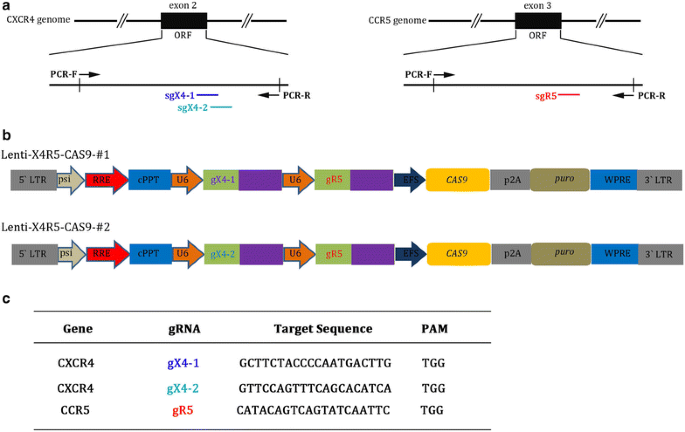
)清晰展示了sgRNA的靶向位点及载体结构,T7核酸内切酶I(T7E1)检测显示,在TZM-bl细胞中,lenti-X4R5-Cas9-#1对CXCR4和CCR5的插入/缺失(indel)突变率分别为20.35%和15.90%,lenti-X4R5-Cas9-#2的突变率分别为40.57%和32.95%(n=3,P<0.05),DNA测序进一步验证了编辑的特异性。
产品关联:文献未提及具体实验产品,领域常规使用慢病毒载体构建试剂盒、PCR扩增试剂、T7核酸内切酶等。
3.2 TZM-bl细胞系中编辑效率与抗HIV效果验证
实验目的:验证双靶向CRISPR系统在上皮来源CD4+细胞系中的编辑效率及对不同嗜性HIV-1的抗性。
方法细节:将两种lenti-X4R5-Cas9载体通过脂质体转染TZM-bl细胞,转染后用1μg/ml嘌呤霉素处理24h以富集编辑细胞,采用T7E1检测基因组水平的indel率,流式细胞术检测细胞表面CXCR4和CCR5的表达水平;随后分别用CXCR4嗜性HIV-1NL4-3或CCR5嗜性HIV-1YU-2感染细胞,感染72h后通过荧光素酶报告实验检测病毒感染水平。
结果解读:T7E1实验结果显示两种载体均能有效编辑CXCR4和CCR5基因(
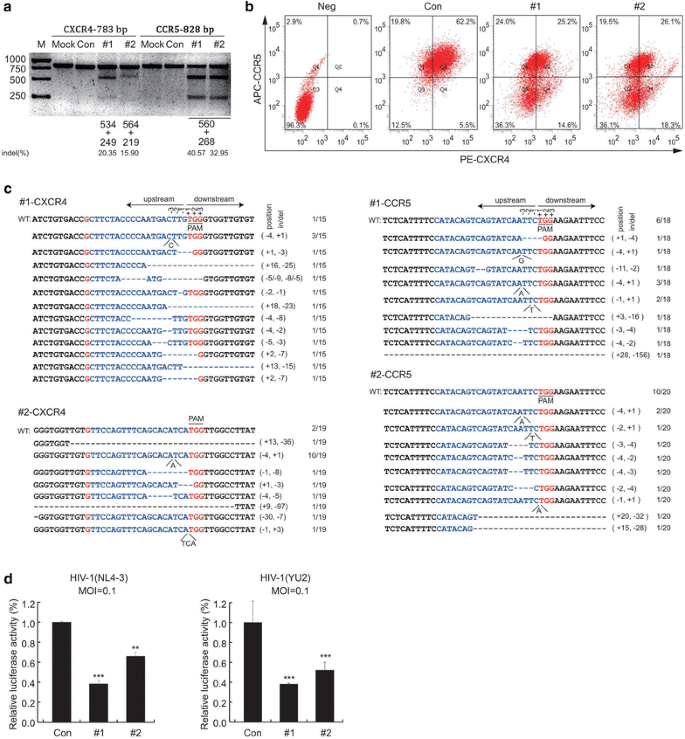
a);流式细胞术结果显示,编辑细胞表面CXCR4和CCR5的表达水平较对照组显著下调(
b);HIV-1感染实验显示,双编辑细胞对两种嗜性HIV-1的抗性均显著高于对照组,其中lenti-X4R5-Cas9-#2处理组的病毒抑制效果更显著(n=3,P<0.01)(
d)。
产品关联:实验所用关键产品:PEI转染试剂(Sigma)、嘌呤霉素(Sigma)、PE标记抗CXCR4抗体、APC标记抗CCR5抗体(Biolegend)、T7核酸内切酶I(NEB)。
3.3 Jurkat T细胞系中编辑效率、抗HIV效果及选择性优势分析
实验目的:验证双靶向CRISPR系统在T细胞系中的编辑效率、抗HIV效果,以及编辑细胞在HIV-1感染过程中的选择性优势。
方法细节:将包装好的X4R5-Cas9慢病毒以感染复数(Multiplicity of Infection, MOI)=40转染Jurkat T细胞,转染后用嘌呤霉素筛选富集编辑细胞;采用T7E1及DNA测序检测基因组编辑效率,流式细胞术检测细胞表面CXCR4表达(Jurkat细胞CCR5表达水平低,仅检测CXCR4),Western blot检测细胞内CXCR4和CCR5的总蛋白水平;分别用HIV-1NL4-3或YU-2感染细胞,在感染后1、3、5天检测细胞上清中HIV-1 p24抗原水平;同时将编辑细胞与未编辑细胞混合,用1:1的HIV-1NL4-3和YU-2混合毒株感染,培养18天,定期提取细胞基因组DNA检测indel率变化,评估编辑细胞的选择性优势。
结果解读:T7E1及DNA测序验证Jurkat细胞中CXCR4和CCR5基因均被有效编辑(
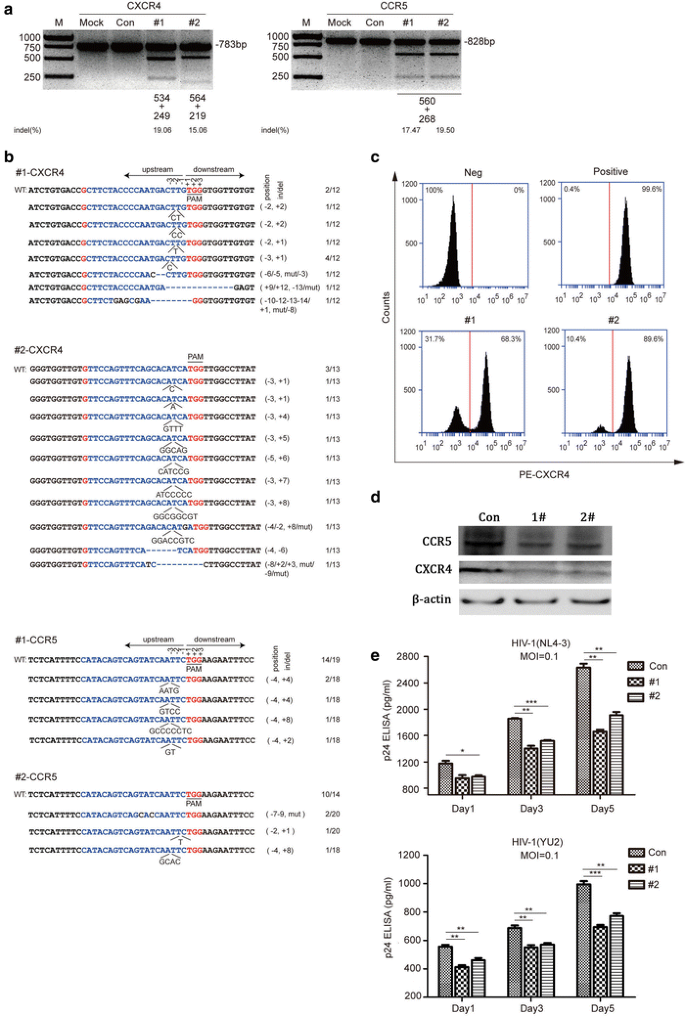
a、b);流式细胞术及Western blot结果显示,编辑细胞的CXCR4和CCR5表达水平显著下调(
c、d);p24抗原检测显示,编辑细胞的病毒复制水平显著低于对照组(
e);选择性优势实验显示,感染18天后,编辑细胞的indel率较感染前显著升高,说明编辑细胞在HIV-1感染过程中逐渐富集,具有明显的生存优势(
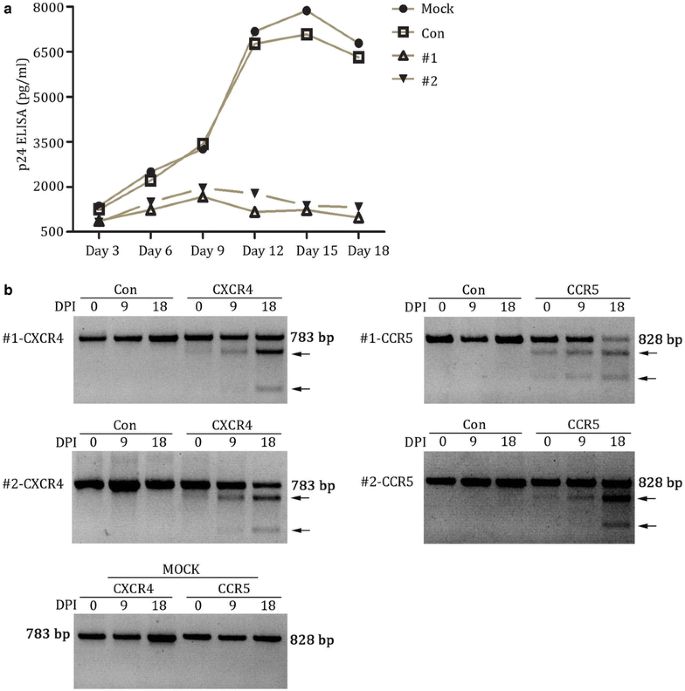
a、b)。
产品关联:文献未提及具体实验产品,领域常规使用慢病毒包装试剂盒、Western blot抗体、p24 ELISA试剂盒等。
3.4 原代CD4+T细胞中编辑效率与抗HIV效果验证
实验目的:验证双靶向CRISPR系统在原代CD4+T细胞中的编辑效率及对不同嗜性HIV-1的抗性,对比单一共受体编辑与双共受体编辑的效果差异。
方法细节:从健康供者的外周血单个核细胞(Peripheral Blood Mononuclear Cells, PBMC)中分离富集原代CD4+T细胞,通过电穿孔将lenti-X4R5-Cas9载体转染细胞;采用T7E1及深度测序检测基因组indel率;分别用HIV-1NL4-3、YU-2或两者混合毒株感染细胞,在感染后1、3、5、7天检测细胞上清中p24抗原水平,同时设置单一CCR5编辑组、单一CXCR4编辑组及未编辑对照组作为对比。
结果解读:T7E1及深度测序结果显示,原代CD4+T细胞中CXCR4和CCR5基因被有效编辑(
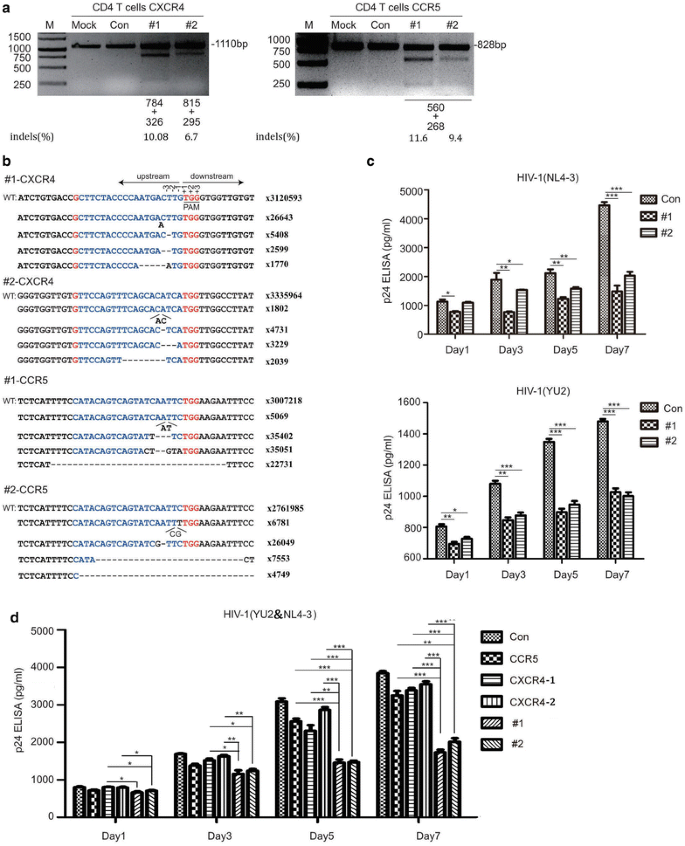
a、b);p24抗原检测显示,双共受体编辑细胞对单一嗜性及双嗜性HIV-1的抗性均显著高于对照组及单一共受体编辑组,其中双编辑组在感染第7天的p24水平较对照组降低约70%(n=3,P<0.001)(
c、d)。
产品关联:实验所用关键产品:人CD4+T细胞分离试剂盒(Miltenyi Biotech)、Lonza 4D-Nucleofector电转系统、p24 ELISA试剂盒。
3.5 脱靶效应与细胞毒性评估
实验目的:系统评估双靶向CRISPR系统的编辑特异性(脱靶效应)及对原代CD4+T细胞的毒性(凋亡水平)。
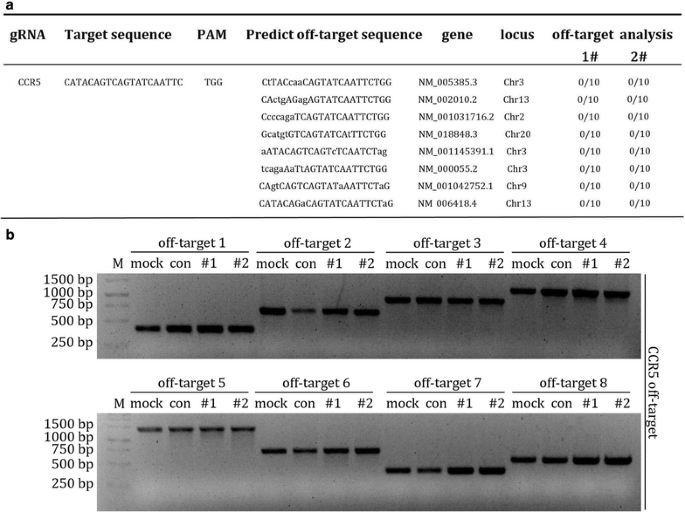
方法细节:利用在线工具(http://crispr.mit.edu)预测CXCR4和CCR5 sgRNA的潜在脱靶位点,从编辑后的原代CD4+T细胞中提取基因组DNA,通过PCR扩增潜在脱靶位点的片段,采用T7E1及DNA测序检测突变情况;同时在转染后1、3、5天,用Annexin V/7-氨基放线菌素D(7-Aminoactinomycin D, 7-AAD)染色编辑细胞,通过流式细胞术检测细胞早期凋亡率,评估细胞毒性。
结果解读:脱靶分析结果显示,所有预测的潜在脱靶位点均未检测到非特异性突变,证明该系统具有高度的编辑特异性(
a、b);凋亡检测结果显示,编辑细胞的早期凋亡率与未编辑对照组无显著差异(n=3,P>0.05),说明双共受体编辑对原代CD4+T细胞无明显细胞毒性(
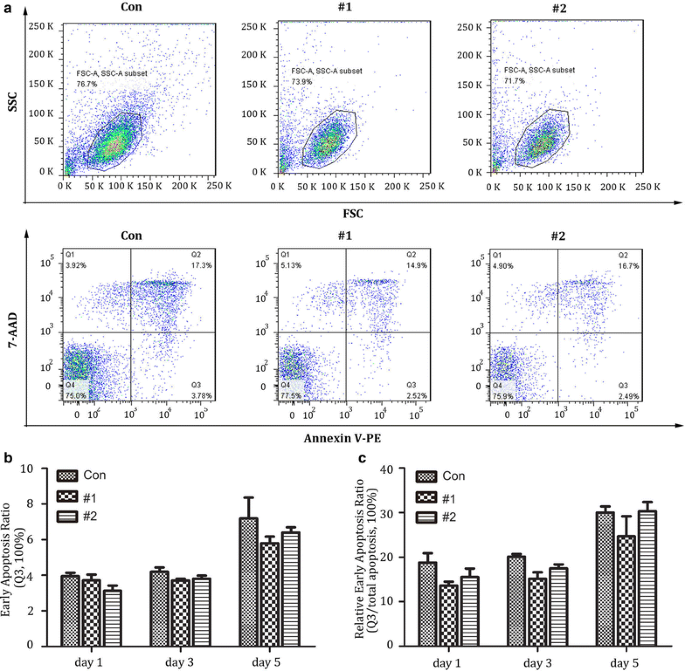
a、b、c)。
产品关联:实验所用关键产品:Annexin V凋亡检测试剂盒(BD Pharmingen)、流式细胞仪(BD Aria III)。
4. Biomarker研究及发现成果解析
本研究中的功能性生物标志物为CCR5和CXCR4基因的indel突变(基因组水平)及细胞表面蛋白表达下调(蛋白水平),其作为HIV-1感染抗性标志物的筛选与验证逻辑为:基于HIV-1入侵细胞的共受体依赖机制,设计sgRNA靶向CCR5和CXCR4编码区,通过CRISPR-Cas9诱导基因功能缺失突变,经细胞系及原代细胞的编辑效率验证、抗HIV效果验证、特异性及安全性验证,明确其作为抗HIV生物标志物的价值。
该Biomarker的基因组水平突变来源于CRISPR-Cas9诱导的CCR5和CXCR4基因indel,蛋白水平标志物为细胞表面CXCR4和CCR4表达下调;验证方法包括T7E1、深度测序检测基因组突变率,流式细胞术检测蛋白表达水平,HIV-1感染实验验证抗性功能;特异性数据显示,该系统的编辑特异性为100%(所有预测脱靶位点均无突变),敏感性方面,双编辑细胞对HIV-1的抑制率显著高于单一编辑组,其中对双嗜性HIV-1的抑制率在感染第7天可达约70%(n=3,P<0.001)。
该Biomarker的核心功能关联为:CCR5和CXCR4双基因编辑可使CD4+T细胞同时抵抗CCR5嗜性、CXCR4嗜性及双嗜性HIV-1的感染,且编辑细胞在HIV-1感染过程中具有选择性生存优势;创新性在于首次系统验证了两种不同sgRNA组合的双共受体编辑效果,证明双编辑的抗HIV效果显著优于单一编辑,同时全面证实了系统的高特异性与低细胞毒性;统计学结果显示,双编辑组的p24水平较对照组降低约70%(n=3,P<0.001),早期凋亡率与对照组无显著差异(P>0.05)。
特别声明
1、本页面内容包含部分的内容是基于公开信息的合理引用;引用内容仅为补充信息,不代表本站立场。
2、若认为本页面引用内容涉及侵权,请及时与本站联系,我们将第一时间处理。
3、其他媒体/个人如需使用本页面原创内容,需注明“来源:[生知库]”并获得授权;使用引用内容的,需自行联系原作者获得许可。
4、投稿及合作请联系:info@biocloudy.com。